
Flageolet de Touraine
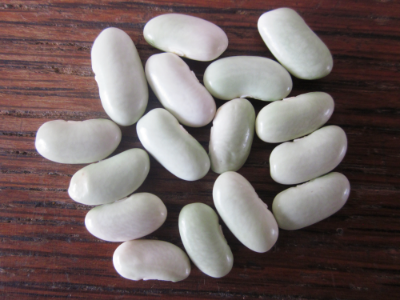
(Bush) Flageolet de Touraine is a landrace variety from the city of Tours in France. The seeds are a mix of white and light green. The name ‘Flageolet de Touraine’ is derived from that of the French province of Touraine. Touraine was notably named for its ancient inhabitants, the Gallic/Celtic tribe ‘Turones’. 4, 5
Days to Maturity:

History
The Flageolet de Touraine was rediscovered by ‘Ferme de Sainte-Marthe’ (now ‘Mille Variétés Anciens’) in Sologne, France. 1, 2, 3 The Flageolet de Touraine initially appeared in their seed catalogue in the early 1990s as “flageolet de Pays”. 1 It was later listed as “de Touraine”. 1
Flageolet de Touraine is actively preserved by L’Union pour les Ressources Génétiques du Centre-Val de Loire (URGC). According to the URGC,
“Le flageolet de Touraine ne figure pas dans les archives des catalogues de semenciers du 20ème siècle ; la seule mention d’un haricot en Touraine concerne le “Soissons de Touraine”, une variété très proche du haricot de Soissons : on est donc bien loin de notre petit flageolet. Ce haricot est donc ce que l’on appelle une variété de pays : sa culture était probablement limitée à sa région d’origine, et les semences s’échangeaient directement entre jardiniers.” 1
[English: “The flageolet of Touraine does not appear in the archives of the seed catalogues of the 20th century; the only mention of a bean in Touraine concerns the “Soissons of Touraine”, a variety very close to the bean of Soissons: it is therefore far from our small flageolet. This bean is therefore what is called a variety of countries: its cultivation was probably limited to its region of origin, and seeds were exchanged directly between gardeners.” 1]
Origin
Flageolet de Touraine comes from the city of Tours in the French department of Indre-et-Loire. 4 The city of Tours was historically the capital of Touraine province, « le verger de la France ». 7 It is located in the Centre-Val de Loire (the Loire Valley) in France. Since the late 15th century the Centre-Val de Loire region has been known as « Jardin de la France ». 7 Originally Touraine was a royal duchy and garnered a reputation for being where France’s kings “from Charles VII to Henry IV [lived], in their castles of the Loire”. 5
In 1584 Touraine lost its duke François d’Alençon (1576-1584) 5, and became a province. 4 Around 1789-1790 it was divided into departments (Indre-et-Loire, Loir-et-Cher, Indre, and Vienne). 4, 6