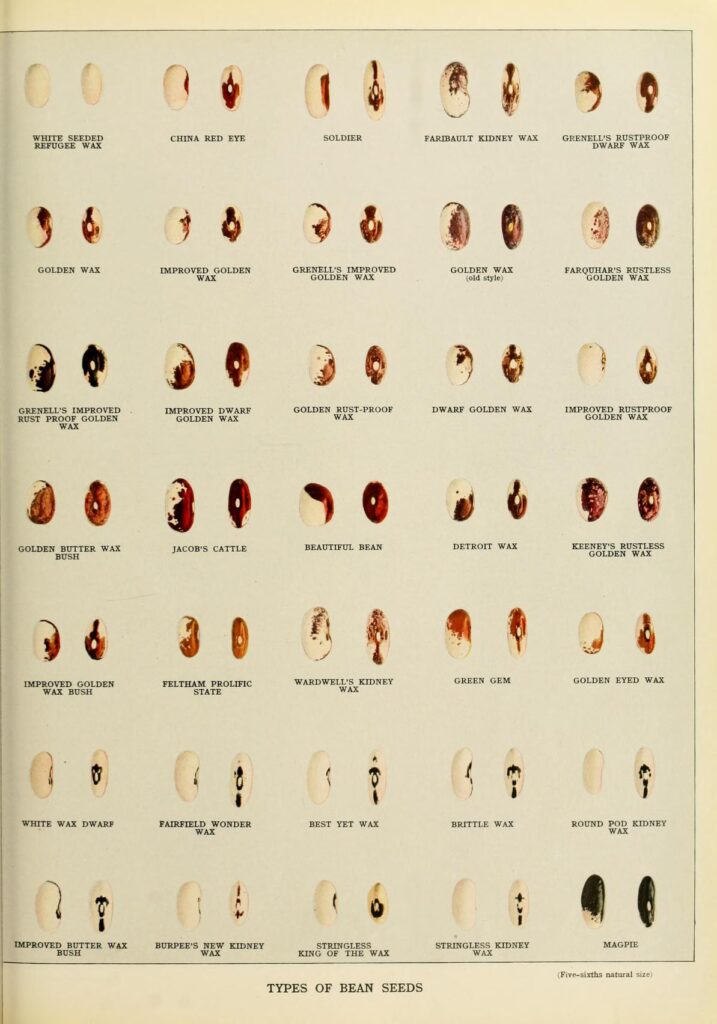
Jacob’s Cattle
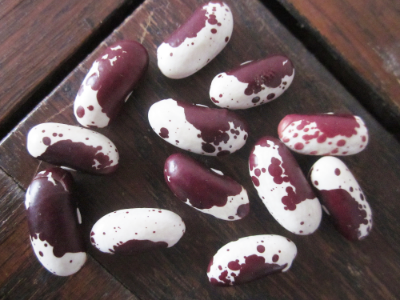
(Bush) A popular heirloom bean named for the Bible story of Isaac and Rebecca’s son Jacob. Jacob tended his father in law, Laban’s, flocks and made a deal with him for his spotted cattle in Genesis 30 25-43.
Days to Maturity:

Origin
The origin of this variety is uncertain. Within the 21st century its origin has been attributed to both the Passamaquoddy indigenous people of Maine and the 1800s German and Czech immigrants of Texas [Note: according to Hedrick, U.P., the ‘Trout’ bean is likely the variety of German origin].
“The first domesticated bean is of New World origin and was first cultivated in Ancient Andes. The Jacob’s Cattle bean is an heirloom of Prince Edward Island. Though no perfect facts point to its cultivated origins, myth and legend has it that it was cultivated by the Passamaquoddy Indians during the 17th Century. Shelling beans were a quintessential foundation of Native American agriculture. Jacob’s Cattle shelling beans are one of hundreds of heirloom shelling bean varieties that are native to North America, though many have disappeared from the agricultural landscape. Jacob’s Cattle shelling beans are a perfect example. They were once common and then went into obscurity as improved varieties became commonplace. The late 20th Century has brought a resurgence of heirloom beans and because of Jacob’s Cattle’s unique appearance and productive yields, it is becoming a relevant shelling bean once again. It can be found at farmers markets and via specialty stores.” 2
“Jacob’s Cattle bean is the oldest name given to this variety, also known as the Trout or Appaloosa bean, that originates from the northeastern United States and southeastern Canada. The Passamaquoddy indigenous people of Maine were said to have given some as a gift to Joseph Clark, the first Caucasian child born in Lubec, Maine in the 1600s. Even through the late 1900s, this bean had a very local distribution limited to the northeastern United States, and particularly Maine, and Prince Edward Island, Canada.” 3
“Jacob’s Cattle Beans have a rich history in Texas. They were first brought to the state by German and Czech immigrants in the 1800s.” 4
In the 1928 publication ‘The vegetables of New York’ by U.P. Hedrick,

“This bean with such unusual seed color is of unknown origin and quite local distribution in Maine, but it may be identical with the Trout bean of northwestern Massachusetts, New Hampshire, and Vermont of which we have been unable to obtain seed or direct references. The latter is probably the German bean Forellen.” (Pg 78, 79, The vegetables of New York Part II: Beans, U.P. Hendrick, 1928)